
Vienna Public Transport: U-Bahn, Trams & Which Ticket to Buy
U-Bahn metro, vintage trams, Vienna Card, CitiBike cycling, and walking the compact Innere Stadt — everything you need to get around Vienna
Powered by ITINE
Get this guide as a tappable itinerary
Day-by-day plan, audio tours, and one-tap Google Maps — completely free.
Destinations
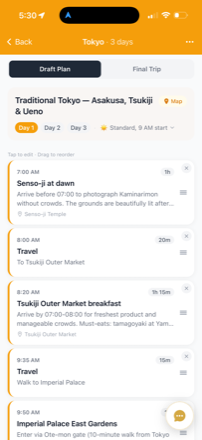
Your Itinerary
Google Maps
Getting around Vienna is excellent. The city has one of Europe's best public transport systems — a 5-line U-Bahn (metro) that covers the entire city, an extensive tram network including scenic vintage vehicles, and frequent buses. The Vienna Card (€17/24hr, €25/48hr, €29/72hr) covers unlimited travel on all public transport plus discounts at 210+ attractions. The Innere Stadt is compact and walkable — you can cross the historic centre in 15 minutes on foot. For summer visits, CitiBike Vienna offers free cycling for the first 30 minutes along the city's 1,500+ km of bike paths.
The key rule: walk the centre, metro for longer distances, and trams for scenic journeys. Download the WienMobil app for real-time departures, route planning, and ticket purchases.
Efficient public transport makes it easy to reach Vienna's top attractions — take the U4 directly to Schoenbrunn Palace, ride the U1 or U3 to Stephansdom in the heart of the city, or walk from the Ringstrasse tram stop to the Hofburg Palace. For everything you need to know about getting from the airport to the city centre, including the CAT, S-Bahn, and taxi options, see our dedicated Vienna airport guide.
Transport Options
U-Bahn (Metro)
Recommended€2.40/single ride, or Vienna Card (€17/24hr)Vienna's U-Bahn is clean, efficient, safe, and covers the entire city with 5 lines (U1-U6, no U5 yet). Trains run every 2-5 minutes during the day and every 5-10 minutes evenings. The system runs from approximately 5 AM to midnight on weekdays, and 24 hours on Friday and Saturday nights. Key stations: Stephansplatz (city centre), Karlsplatz (opera/Naschmarkt), Schönbrunn (palace), Praterstern (Prater). Validate tickets before boarding at the blue machines.
Pros
- + Covers the entire city — the backbone of Vienna transport
- + Fast, frequent, and reliable (2-5 minute intervals)
- + Clean, safe, and modern stations
- + 24/7 service on Friday and Saturday nights
- + Children under 6 ride free
- + Efficient connections between all major attractions
Cons
- - Stops running at midnight on weekdays (NightLine buses take over)
- - Can be crowded during rush hours (7:30-9 AM, 5-6:30 PM)
- - Some older stations lack lifts — check accessibility in advance
- - No service on the U5 line yet (under construction)
Tip: Buy a Vienna Card for unlimited travel or single tickets from machines at every station. Validate before boarding — plain-clothes inspectors check regularly and fines are €105. The WienMobil app shows real-time departures. For Schönbrunn, take U4 to Schönbrunn station. For the Prater, take U1 or U2 to Praterstern.
Trams (Straßenbahn)
RecommendedIncluded in Vienna Card and standard ticketsVienna has one of the world's largest and oldest tram networks — over 30 lines operating a mix of charming vintage and sleek modern vehicles. The tram is the most scenic way to travel, especially the Ring tram (lines 1 and 2) which circles the Ringstraße past the Opera, Hofburg, Parliament, Rathaus, and Burgtheater. Trams run frequently from 5 AM to midnight. They reach areas the U-Bahn does not, particularly in outer districts.
Pros
- + The most scenic public transport — see the city as you travel
- + Ring tram (lines 1/2) is a free sightseeing tour with a standard ticket
- + Reaches areas the U-Bahn does not cover
- + Frequent service throughout the day
- + A charming, quintessentially Viennese experience
- + Accessible with low-floor modern vehicles
Cons
- - Slower than the U-Bahn for longer distances
- - Can be delayed by traffic on shared road sections
- - Vintage trams have steps — less accessible for wheelchairs/strollers
- - Routes can be confusing for first-time visitors — use WienMobil app
Tip: Take tram 1 or 2 around the Ringstraße for a free sightseeing tour — the entire loop takes about 25 minutes and passes all the grand Ringstraße buildings. Tram D runs from the Ringstraße to Nussdorf (wine village) through beautiful residential areas. Validate your ticket on board. The WienMobil app shows real-time tram positions.
Walking
RecommendedFreeThe Innere Stadt (1st district) is compact, largely pedestrian-friendly, and perfect for walking. You can cross the historic centre on foot in 15-20 minutes. Walking is the best way to appreciate Vienna's architecture, discover hidden courtyards (Durchhäuser), browse shop windows on the Graben and Kohlmarkt, and stumble upon coffeehouses. The Ringstraße loop is a magnificent 5.3 km walk. Early morning walks offer the quietest, most atmospheric experience.
Pros
- + The Innere Stadt is compact and walkable — no transport needed
- + Best way to appreciate architecture and discover hidden gems
- + Free — no tickets needed
- + The Ringstraße loop is a world-class walking experience
- + Safe streets with good pedestrian infrastructure
Cons
- - Not practical for Schönbrunn (4 km), Prater (2 km), or outer districts
- - Summer heat (30-35°C) can make extended walks tiring
- - Cobblestones in the old town — wear comfortable shoes
- - Winter can be cold and icy — dress warmly
Tip: Walk the Ringstraße in the morning when the light on the buildings is beautiful. Wear comfortable shoes — Vienna's cobblestones demand it. The passage through the Hofburg from Michaelerplatz to Heldenplatz is magnificent. Early morning (7-9 AM) offers the quietest experience in the tourist areas. Carry water in summer.
Cycling (CitiBike Vienna)
Good OptionFirst 30 min free (€1 registration), €1-4/hr afterVienna has over 1,500 km of bike paths and a public bike-sharing system called CitiBike Vienna. Register online or at any station (€1), then the first 30 minutes of each ride are free. The Danube Canal path, Danube Island (21 km car-free), the Ringstraße bike lane, and the Prater park offer excellent cycling. Dedicated bike lanes on many major roads make cycling safe. Vienna is flat — cycling is effortless.
Pros
- + First 30 minutes free with CitiBike — perfect for short hops
- + Over 1,500 km of dedicated bike paths
- + Flat terrain makes cycling effortless
- + Danube Island is a 21 km car-free cycling paradise
- + Excellent way to explore the Prater and canal area
- + Eco-friendly and healthy
Cons
- - Within the compact 1st district, walking is easier than cycling
- - Watch for tram tracks — cross them at an angle to avoid wheel trapping
- - Winter cycling is cold and occasionally icy
- - CitiBike stations can be empty during peak hours — check the app
Tip: Register for CitiBike online before your trip. Return bikes within 30 minutes to keep it free — simply dock at any station and re-take for another free 30 minutes. The Danube Canal path from Schwedenplatz to Nussdorf is a beautiful ride. For longer rides, rent from private shops (€15-25/day). Always lock your bike.
Taxi / Uber / Bolt
Available€5-15 within the city, €36 fixed to airportTaxis, Uber, and Bolt are available throughout Vienna but rarely necessary given the excellent public transport. Most useful for late-night rides (when the U-Bahn stops on weekdays), airport transfers, and group travel. Vienna taxis are metered and reliable. Uber and Bolt offer similar prices with app-based booking. The fixed taxi rate to the airport is €36 — competitive with the CAT train.
Pros
- + Available 24/7 including late nights
- + Fixed €36 rate to the airport from anywhere in Vienna
- + Uber and Bolt apps work seamlessly
- + Good for groups splitting the fare
- + Handles luggage easily
Cons
- - Unnecessary for most Vienna exploration — public transport is better
- - More expensive than U-Bahn and trams
- - Traffic can cause delays during rush hours
- - Short rides in the 1st district are faster on foot
Tip: Use taxis/Uber mainly for airport transfers and late-night rides. The fixed €36 airport rate is set by the city — all taxis must offer it. Uber and Bolt often match or beat taxi prices. For the airport, compare the €36 taxi, €14.90 CAT train, and €4.40 S-Bahn to choose the best option for your situation.
Vienna Card Options
24-Hour Card
€17
Unlimited U-Bahn, tram, and bus travel for 24 hours plus discounts at 210+ attractions, restaurants, and shops. Best for short visits.
48-Hour Card
€25
Two full days of unlimited transport plus attraction discounts. The sweet spot for most visitors on a 2-3 day trip. Better per-day value than the 24-hour card.
72-Hour Card
€29
Three full days of unlimited transport. The best value per day at under €10. Ideal for 3+ day stays. Discounts accumulate significantly over three days of museum-hopping and attraction visits.
Ticket Types & Validation
Important: Validate Your Ticket
Vienna operates an honour system — there are no ticket barriers. You must validate your ticket at the blue machines before boarding. Plain-clothes inspectors check regularly and the fine for traveling without a valid ticket is €105. The Vienna Card is pre-validated when purchased. Single tickets must be stamped at the machine.
- Single ride: €2.40 — valid for one journey including transfers (no return trips)
- 24-hour ticket: €8 — unlimited travel from first validation (cheaper than Vienna Card if you do not want discounts)
- 48-hour ticket: €14.10 — two days of unlimited travel
- 72-hour ticket: €17.10 — three days of unlimited travel
- Weekly ticket: €17.10 — Monday 00:00 to following Monday 09:00
- Children under 6: Free on all public transport
- Children 6-14: Free on Sundays, public holidays, and school holidays. €1.20 single ride otherwise
Vienna is also a gateway to other Central European capitals. Direct OeBB Railjet trains reach Prague in about four hours, making it easy to combine both cities — see our Vienna vs Prague comparison to decide how to split your time. If you are arriving by air, the airport guide covers every transfer option from VIE to the city centre.
Vienna Transport FAQs
Get Your Free Travel Guide
PDF download + weekly travel tips
Join our community and get a comprehensive travel guide with maps, budgets, and insider tips delivered to your inbox.
Unsubscribe anytime. No spam, we promise.